
Hanif Esmail
Co-founder & Lead Audio Engineer · DJ Friktion
Twenty years of professional audio engineering, now spent making sure a routine sounds deliberate from the first beat to the last.
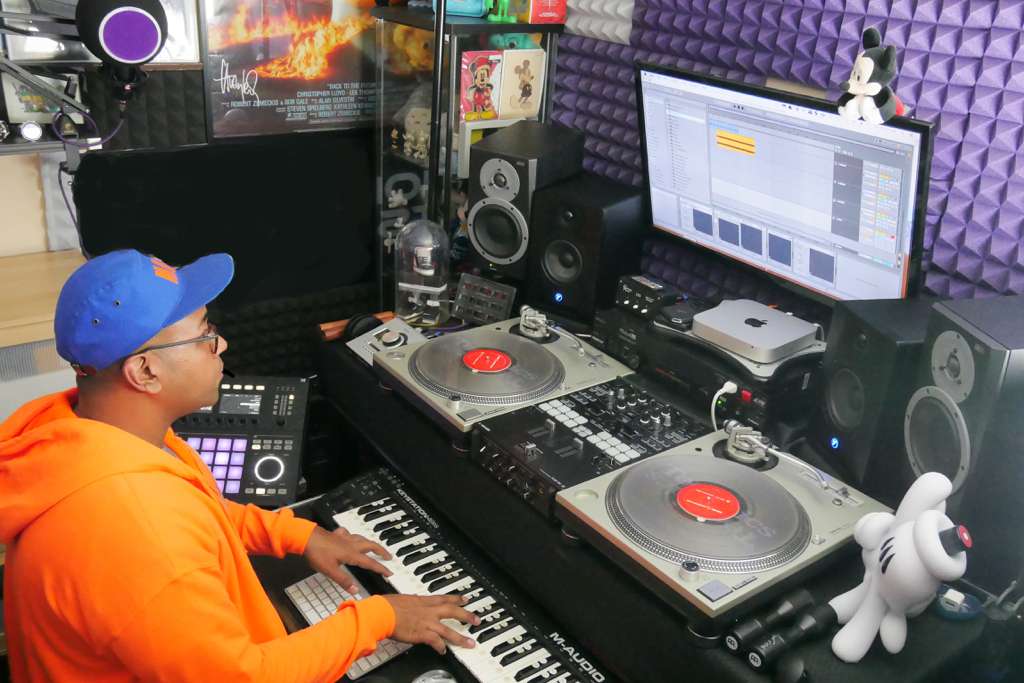
Hanif joined the entertainment scene in 1998 as DJ Friktion of The Goodfellas, teaching himself to blend, scratch and mix by studying the deejays he admired. An open-format upbringing gave him the range to work club, wedding and corporate crowds with equal ease, with hip hop, house, R&B and reggae as his home genres.
In 2005 he started writing remixes and edits for other deejays to play, and found he had a real talent for it. By 2010 he and his business partner, Sid Smooth, were invited to join Crooklyn Clan, a prestigious remix boutique out of New York curated for working deejays worldwide — where their edits and remixes climbed to #1 and stayed there.
That is the same craft a competition edit needs: hundreds of hours spent learning where music naturally turns, the techniques that make a transition point read as clean, and an ear for which instruments and vibes belong together. Editing and creating music is what Hanif does best.
Track record
- DJ since 1998, performing as DJ Friktion of The Goodfellas
- Writing remixes and edits professionally since 2005
- #1-charting remixes with Crooklyn Clan, a remix boutique curated for working deejays worldwide
- Winner of multiple deejay battles
Questions Hanif has answered
-
Why does my dance music edit sound amateur?
Obvious cuts usually come from mismatched phrasing, abrupt changes in energy, tempo differences, or inconsistent audio levels. A professional competition edit should sound as though the track was originally produced at the required length.
Read and listen -
Why does my music sound good in headphones but bad at competition?
Headphones deliver the mix directly to your ears in a quiet room. A competition PA is distant, reverberant, and competing with crowd noise, and the frequency balance that reaches the floor is far less even than what headphones deliver. Detail that carried the track on headphones often does not survive the room.
Read and listen -
Can you fix a competition edit that already sounds wrong?
Yes. Send the original full-length tracks along with the edit that is not working, and tell us what bothers you about it. Most problems are solved by rebuilding the transitions from the source material rather than patching the existing file. It is ordered as a normal competition edit.
Read and listen -
Can you shorten a song without making the edit obvious?
Yes. A song can usually lose a third of its length with no audible seam. It works by cutting on phrase boundaries instead of to a stopwatch, matching the energy on both sides of the join, and placing the seam where something in the arrangement already covers it.
Read and listen -
Can you combine multiple songs into one seamless mix?
Yes. Combining songs well is a matter of matching rather than fading. Tracks at different tempos and in different keys need to be time-aligned and pitch-reconciled before they will sit together. Done properly, a multi-song routine sounds like one arrangement instead of a playlist.
Read and listen -
Can you remove explicit lyrics from competition music cleanly?
Yes. The difference between a clean edit that works and one everybody notices is what replaces the word. Muting leaves a hole in the vocal line. We remove explicit language using a clean release, the instrumental underneath, or a rebuilt phrase, so the vocal keeps its shape.
Read and listen -
How much does professional competition music editing cost?
A single-song competition edit is CA$59 and a multi-song routine edit built from up to 8 songs is CA$99. Additional songs are CA$15 each. Both include 2 revisions per song. Expect to pay more for rush turnaround and for per-song work like lyric cleanup.
Read the full answer -
What should I look for in a competition music editor?
Ask to hear before-and-after examples, check they understand your discipline’s rules, and confirm how many revisions are included and what the turnaround is in business days. An editor who cannot play you their own work is the easiest one to rule out.
Read and listen -
What do I need to send a music editor?
Send the highest-quality audio file you have, your exact target length, and a note about where the key moments in the routine fall. Everything else is optional. Those three things are what separate an edit that lands first time from one that needs two rounds of revisions.
Read the full answer -
What audio format should I use for a dance competition?
A high-bitrate MP3 is accepted at almost every competition and is what most explicitly request. Check your rulebook first — some events specify a format, a naming convention, or an upload deadline. Bring a backup on a second device regardless of what you submit in advance.
Read the full answer
Hear the work first.
Every sample plays the original beside the finished edit. Judge the joins yourself.